



Staff Reporter
Bloemfontein — While attention remains focused on whether the Department of Community Safety, Roads and Transport will implement Judge Corne Van Zyl’s damning judgment, the department’s own history raises questions about its willingness to comply with court orders.
A 2017 Labour Court judgment provides a striking example.
On 30 January 2017, Acting Labour Court Judge Sesi Baloyi — who later served as a commissioner at the Madlanga Commission — delivered judgment setting aside a Bargaining Council finding that had effectively cleared Ntamo of misconduct.
The case followed an internal disciplinary hearing in which Ntamo had initially been found guilty and dismissed by the department on 7 December 2012. The Bargaining Council subsequently issued a finding in his favour, prompting the department to approach the Labour Court.
Ntamo faced two charges of gross misconduct:
The first related to an breach or contravention of the department’s supply chain management policy, Treasury Regulations, supply chain management practice notes and the Public Finance Management Act 1 of 1999.
The second charge concerned gross neglect or dereliction of his duties, functions and responsibilities.
In her judgment, Baloyi overturned the Bargaining Council’s award and substituted it with a finding that Ntamo was guilty on both charges.
Importantly, however, the court did not simply order his dismissal. Instead, it directed that the matter be remitted for a determination of the appropriate sanction, after evidence on mitigating and aggravating circumstances had been considered.
The order stated:
“The award of the commissioner is reviewed and set aside and substituted with the following…”
The court then found Ntamo guilty of misconduct on both charges and directed that the matter be remitted to the appropriate authority for determination of sanction by a different commissioner.
The question is what happened next.
According to information available, the judgment was not implemented in the manner contemplated by the court.
Attempts to facilitate Ntamo’s return to employment were reportedly resisted by then-departmental official Nornan Selai.
That resistance, however, did not last indefinitely.
Ntamo was subsequently re-employed during the tenure of Dr Tshabalala, and, more controversially, was offered remuneration higher than what he had previously received.
This raises a fundamental question: How could an employee whose misconduct had been confirmed by the Labour Court ultimately return to the department under circumstances that allegedly resulted in improved remuneration?
The issue is not merely Ntamo’s return to employment. It is whether the department properly implemented the Labour Court’s order before taking subsequent decisions affecting his employment and remuneration.
The distinction is important.
Judge Baloyi did not pronounce a blanket prohibition against Ntamo ever being employed again. The judgment required the appropriate sanction to be determined after consideration of aggravating and mitigating factors.
Any subsequent employment decision therefore needs to be examined against the actual court order, the sanction process that followed, and the legal and administrative steps taken by the department.
If Ntamo was re-employed without the court-directed sanction process being properly concluded, questions arise about the legality of that decision and another person of interest in Advocate Mopeli but we will come back him and his family..
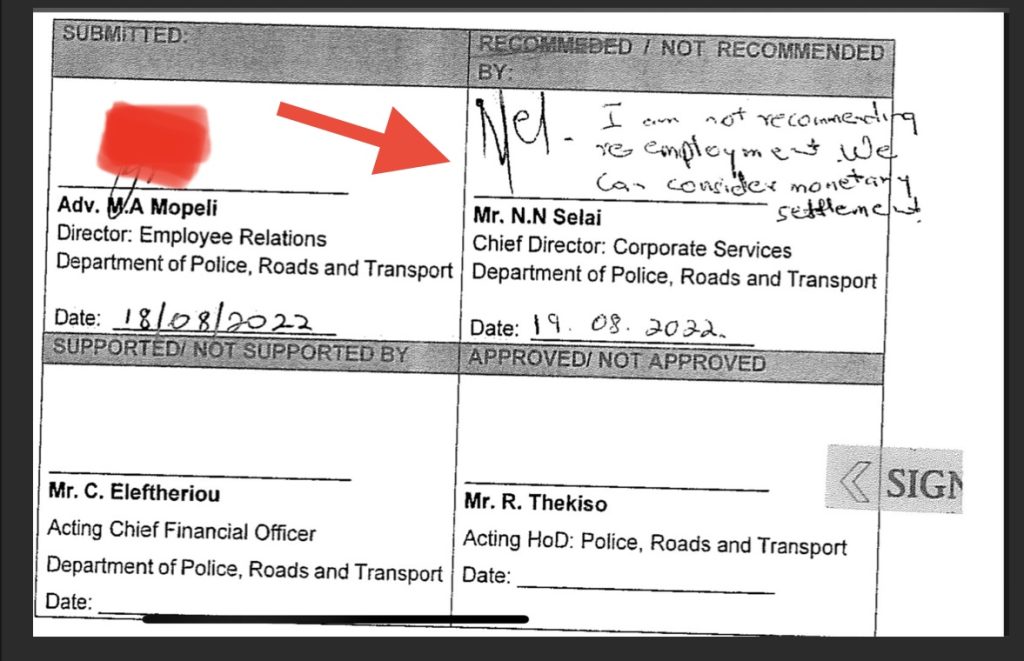
And if his return was accompanied by an increase in remuneration, further questions arise about who authorised it, on what basis, and whether the department followed its own remuneration and recruitment policies.
The circumstances become even more significant in light of the department’s current legal troubles.
The Van Zyl judgment has once again placed the department’s decision-making, acting appointments and administrative conduct under scrutiny. The history surrounding Ntamo suggests that questions about compliance with judicial decisions are not necessarily new.
The central issue is therefore not simply why Ntamo was brought back.
It is whether the department complied with the Labour Court judgment before bringing him back and why his return allegedly came with more money.
Those questions deserve answers from the department, particularly from officials involved in the decision-making process during Dr Tshabalala’s tenure.
In other news the Independent Electoral Commission has filed 282 pages affidavit in response to ANC’s case. The ANC failed to submit names for six municipalities including Mangaung Metro.
On the 5 November many will join unemployment queues.
Support Independent Journalism
Stories like this matter. Accountability matters. Truth matters.
If you believe in fearless, independent reporting that holds power to account, help us keep going.
Your contribution, even as little as R10 makes a difference.
Choane Group (Pty) Ltd
FNB: 63110371703
If you have news or tips please email news@stepupsanews.co.za or WhatsApp: 068 507 6731
Independent. Unbought. Unfiltered.




More Stories
Acting merry-go-round continues at Human Settlements as acting SCM director quits
Mathae’s threats and termination of contracts in the spotlight after court verdict in the Selai matter
“There is no finding in the MPAC report, that warrants such sanctions” – Dihlabeng spin doctor spins a report that recommended MM and CFO to be charged